
Before we begin, if you are a Patreon Corporal Tier member or higher, you can read our more in-depth article at Patreon – Click Here
If you are not a Patreon member, we strongly encourage you to help support our organization by becoming a member, even The $1 a month Private Tier would help.
Now onto the article:
The State Guard & Defense Force Council (Also known as StateDefenseForce.com) held an important meeting yesterday with a Senior Policy Advisor for Defense Budgeting and NATO Policy at a large-scale defense policy NGO based in Washington, D.C., to advance work on what is expected to become a major, in-depth policy backgrounder regarding State Defense Forces across the United States.
Yesterday’s discussion marked our first formal meeting on the project outside of our previous email correspondence. The title of the forthcoming backgrounder has not yet been determined, but its scope is clear: examining why State Defense Forces remain vital components of America’s State military structure, identifying the challenges threatening their continued effectiveness, and developing concrete policy recommendations for Governors, State Legislatures, Adjutants General, and other policymakers.
The Senior Policy Advisor, who is also a U.S. Army combat veteran, has wide-ranging responsibilities that include advising the Legislative and Executive Branches on U.S. defense budgeting and national defense policy.
State Defense Force Uniform Policy Was a Major Focus
A significant portion of the conversation concerned the State Guard & Defense Force Council’s growing concerns regarding the civilianization of State Defense Force uniforms.
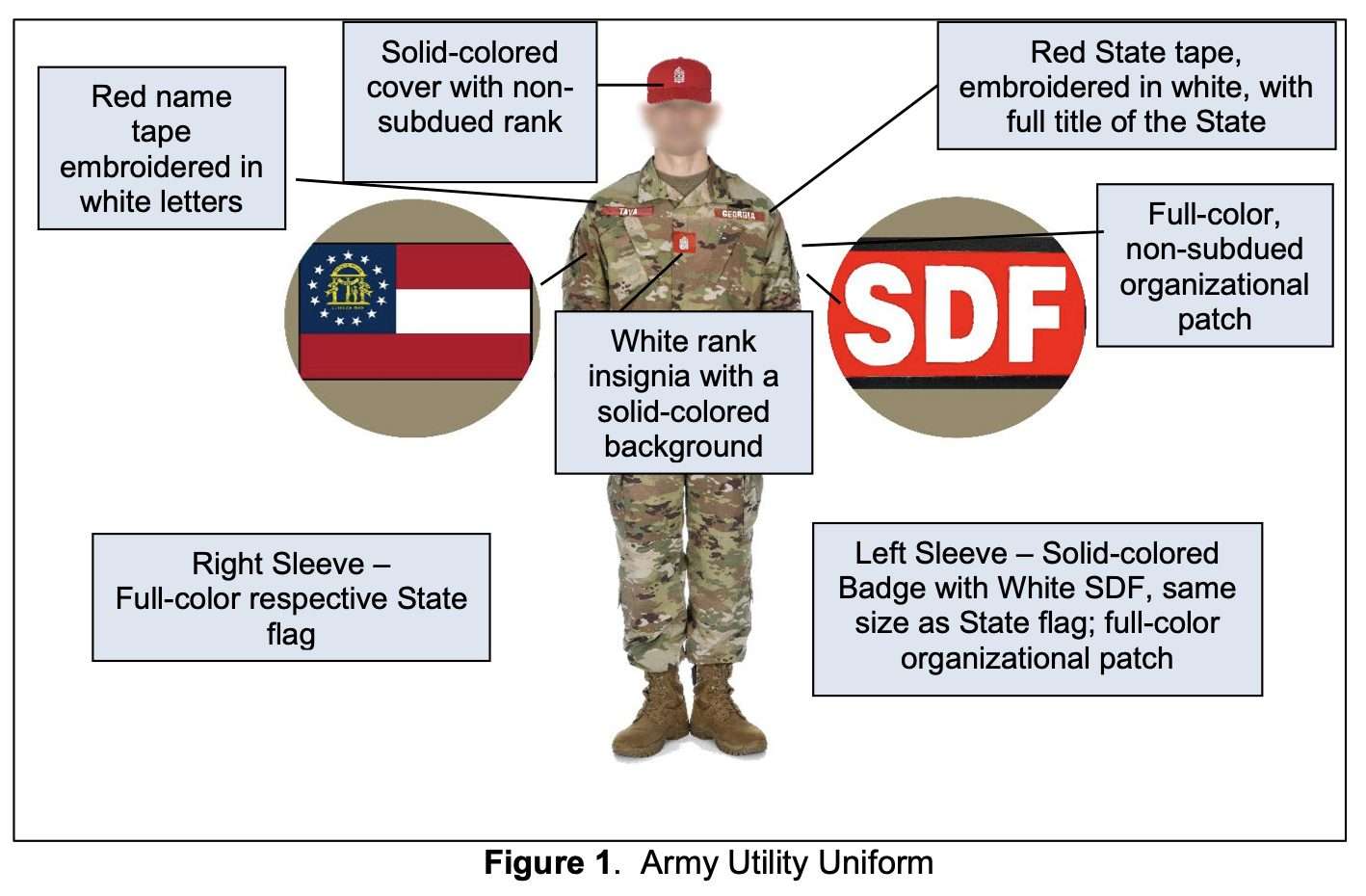
We discussed CNGBI 5500.01A, the National Guard Bureau instruction that recommends distinctive State Defense Force uniform markings, including Red or Bold colored nametapes, rank insignia, headgear, and a large Red “SDF” identification patch. Particular attention was given to the increasingly common use of bright red identifying components, including red nametapes, red rank insignia, red baseball caps, and red “SDF” patches and how these uniforms could affect mission effective and even risk the lives of Americans

During the meeting, we relayed concerns raised by State Guard commanders, Army National Guard personnel, military veterans, and senior advisors to the State Guard & Defense Force Council (Also known as StateDefenseForce.com). We discussed the confusion that over a century of State Defense Forces wearing a military uniform to a Polo & Khakis one or a highly modified one that would cause confusion among the populace during times when zero-hesitation regarding the identity of these military troops are needed. I reinforced that we were perplexed that such a uniform change was recommended to all Adjutant Generals and Governors without any cause or reason. However as one High Ranking Army National Guard Officer informed us that the reason behind such a uniform change is territorial. That some in key State Military Leadership positions want The State Defense Force either civilianized or appear completely different than National Guard troops, which is a drastic shift in policy as for over a century State Defense Force troops wore a military uniform.
Our position is that uniform policy is a serious operational and safety issue when State Defense Force personnel are expected to perform serious military-support and emergency-response missions.
State Defense Force personnel may be tasked with Search and Rescue, Points of Distribution, shelter operations, disaster response, logistics, communications, internal security support, and other missions in which rapid recognition, authority, professionalism, and public confidence is critically important.
We also discussed recent developments involving the Maryland Defense Force, including its movement away from the already modified Operational Camouflage Pattern uniform which already incorporated red nametape identifying features toward a polo shirt and khaki pants uniform.
The Senior Policy Advisor quickly expressed shock upon learning that State military personnel uniforms were being converted to such civilian-style uniforms and raised concerns about the potential serious consequences for both the troops themselves and the citizens placed under their care.
Military uniforms are more than clothing. They contribute to organizational identity, discipline, cohesion, pride in service, and the understanding that an individual belongs to a military organization entrusted with serious responsibilities. They also provide an important element of command presence, public recognition, deterrence, and force protection when State Defense Force personnel are performing public-facing emergency missions.
This is especially important during shelter operations and shelter management, where State Defense Force troops may be responsible for access control, crowd management, the protection of food, water, medical supplies, and other critical resources, or the internal and exterior security of facilities housing hundreds or even thousands of displaced civilians. During disasters, shortages of supplies, exhaustion, fear, and uncertainty can create tense situations. The immediate visual recognition of a disciplined military formation can help establish order and may discourage individuals from challenging personnel responsible for controlling access or protecting scarce resources.
The same consideration applies to Points of Distribution operations, where State Defense Force personnel may distribute food, water, ice, and emergency supplies while simultaneously managing traffic, controlling access, protecting supplies, and maintaining an orderly distribution site. It also applies during search and rescue operations, infrastructure protection, and operations within damaged or restricted areas, where civilians must be able to immediately distinguish authorized State military personnel from volunteers, contractors, or members of the general public.
State Defense Forces have also performed security missions in particularly sensitive environments. The Ohio Military Reserve augmented correctional personnel at the Cuyahoga County Jail during COVID-era staffing shortages, while the South Carolina State Guard & New York State Guard has provided exterior security support for their States’ Department of Corrections. These assignments illustrate why the appearance of a recognizable military organization can be operationally significant rather than merely ceremonial.
In these circumstances, personnel should not require a civilian to stop, read small lettering on a shirt, examine an identification badge, or ask who they represent before understanding that they are dealing with an official State military force. The objective should be zero-hesitation recognition: a uniform that immediately communicates governmental legitimacy, military organization, accountability, and command presence. A recognizable military uniform that reinforces the authority those troops already possess, which ensures increased public compliance, reduce confusion, and provide a measure of preventive deterrence before a confrontation develops.
The Senior Policy Advisor agreed, while also emphasizing an element often overlooked in discussions about military uniforms: the important role they play in fostering morale, unit cohesion, pride in service, and esprit de corps.
The forthcoming backgrounder is therefore expected to examine uniform policy not simply as an issue of appearance, but as a question involving military identity, operational effectiveness, recruiting, retention, morale, public recognition, and troop and public safety.
The Funding Crisis Facing State Defense Forces
One discussion that went beyond uniforms was State Defense Force funding.
We spent a considerable amount of time examining how dramatically underfunded many State Defense Forces remain despite the significant responsibilities States may expect them to assume during emergencies.
We discussed forces operating with extremely limited annual budgets, some as low as approximately 10,000 for an entire year of training, purchasing uniforms, gear, etc. We discussed how State Defense Force members routinely have to purchase uniforms and equipment with their own money, and the extraordinary reliance States place upon volunteers who contribute their professional skills and personal time to public service.
One example discussed was the Georgia State Defense Force, particularly how this State Defense Force is called to State Active Duty, serving at times for weeks without any compensation for State Active Duty, and the financial burden this inflicts on those who serve and their families.
The Senior Policy Advisor expressed considerable surprise and concern regarding this situation.
The discussion raised a larger policy question that we believe deserves national attention:
If a State considers its State Defense Force important enough to activate during a disaster or emergency, should the men and women answering that call be expected to absorb the financial burden of that service themselves?
We also examined what significantly greater State investment could accomplish and discussed the much larger commitment Florida has made toward developing its State Guard.
The forthcoming backgrounder will recommend to States make increased financial investments in their State Defense Force so they can receive substantial returns in trained personnel, emergency-response capacity, specialized expertise from increased manpower, and military manpower available exclusively to the Governor.
A Critical Capability During an Increasingly Uncertain World
Another major focus was the strategic importance of State Defense Forces during periods of large-scale National Guard federal mobilization.
State Defense Forces occupy a unique place in America’s military structure. Unlike the National Guard, they cannot be called upon or ordered into the Armed Forces of the United States under 32 U.S.C. § 109. They report only to The Governor of The State and abide by the same military rules and regulations as The National Guard.
That distinction becomes especially important as global tensions drastically increase and the possibility of substantial Army and Air National Guard deployments overseas much more likely by the day.
The Senior Policy Advisor strongly emphasized the importance of States retaining a military force capable of stepping forward to augment, support, or assume certain responsibilities of the National Guard when substantial portions of The National Guard are unavailable due to overseas deployments or missions being conducted outside the State.
This is, in many respects, one of the original purposes behind America’s modern State Guard system.
A Governor should not discover during a national crisis that the State has doesn’t have a reserve military capability because National Guard is deployed elsewhere.
Developing National Policy Recommendations
The forthcoming backgrounder is being structured around several major areas such as the modern missions of The State Defense Force. The decline, deactivation or potential loss of State Defense Forces, underfunding of State Defense Forces, the civilianization of State Defense Force uniforms, and many more. For a full breakdown please visit our Office of Government & Legislative Affairs Patreon Post:
The indepth post contains all the particulars of the discussion, outline of the full document and the name of The NGO we are working with. The reason we put this behind a paywall is because Patreon is our primary source of funding these legislative initiatives. We must first pay the staff, keep and maintain the online website – https://legislativeadvocacy.org, and many other expenses associated with performing such legislative activities.
Writing will begin immediately. The current working timeline anticipates approximately one month of research and drafting, with an initial draft targeted for mid-September before beginning the formal review and editorial process.
This distinction is important: the policy recommendations remain under development and will be subject to review before publication.
Nevertheless, this meeting represents an important step forward for State Defense Forces.
The organization with which we are working is a major Washington public policy and defense policy institution whose work reaches policymakers in both Congress and the Executive Branch, including on national-defense issues. Its involvement can bring the challenges facing State Defense Forces before audiences these organizations have rarely been able to reach on their own.
A Potential Turning Point for State Defense Forces
The State Guard & Defense Force Council (Also known as StateDefenseForce.com) believes that such a serious national policy backgrounder, supported by research, historical evidence, operational examples, and actionable recommendations, could substantially change the conversation surrounding America’s State Defense Forces.
That is particularly important as State military organizations around the country confront uniform changes that have introduced red nametapes, red rank insignia, red baseball caps, prominent Red “SDF” badge, and, most recently, policies that are being proposed and already approved to move State Guard personnel into polo shirts and khaki pants.
Our objective is larger than opposing one uniform.
Our objective is to preserve State Defense Forces as military organizations.
Organizations that for over a century have served their State through 2 World Wars, numerous other conflicts such as The War on Terror.
If States expect these men and women to deploy during hurricanes, floods, search-and-rescue operations, civil emergencies, mass-distribution missions, security operations, and periods in which National Guard forces are unavailable or understrength, then State policy should reinforce, not gradually erase, their military identity, readiness, professionalism, and ability to accomplish those missions.
StateDefenseForce.com will continue providing updates as this major project moves forward.
If you wish to support our efforts to roll back these uniform changes, increase funding for State Defense Forces, and expand the mission set of State Defense Forces please either become a Patreon.com member or Donate to our Legislative Funding Division of StateDefenseForce.com.
Thank you to all our Patreons who have brought us to this point, so we can develop and grow State Defense Forces nationwide