Special Thank you to Hope T. for submitting & alerting us to this news. If you wish to submit SDF news please email us at [email protected]
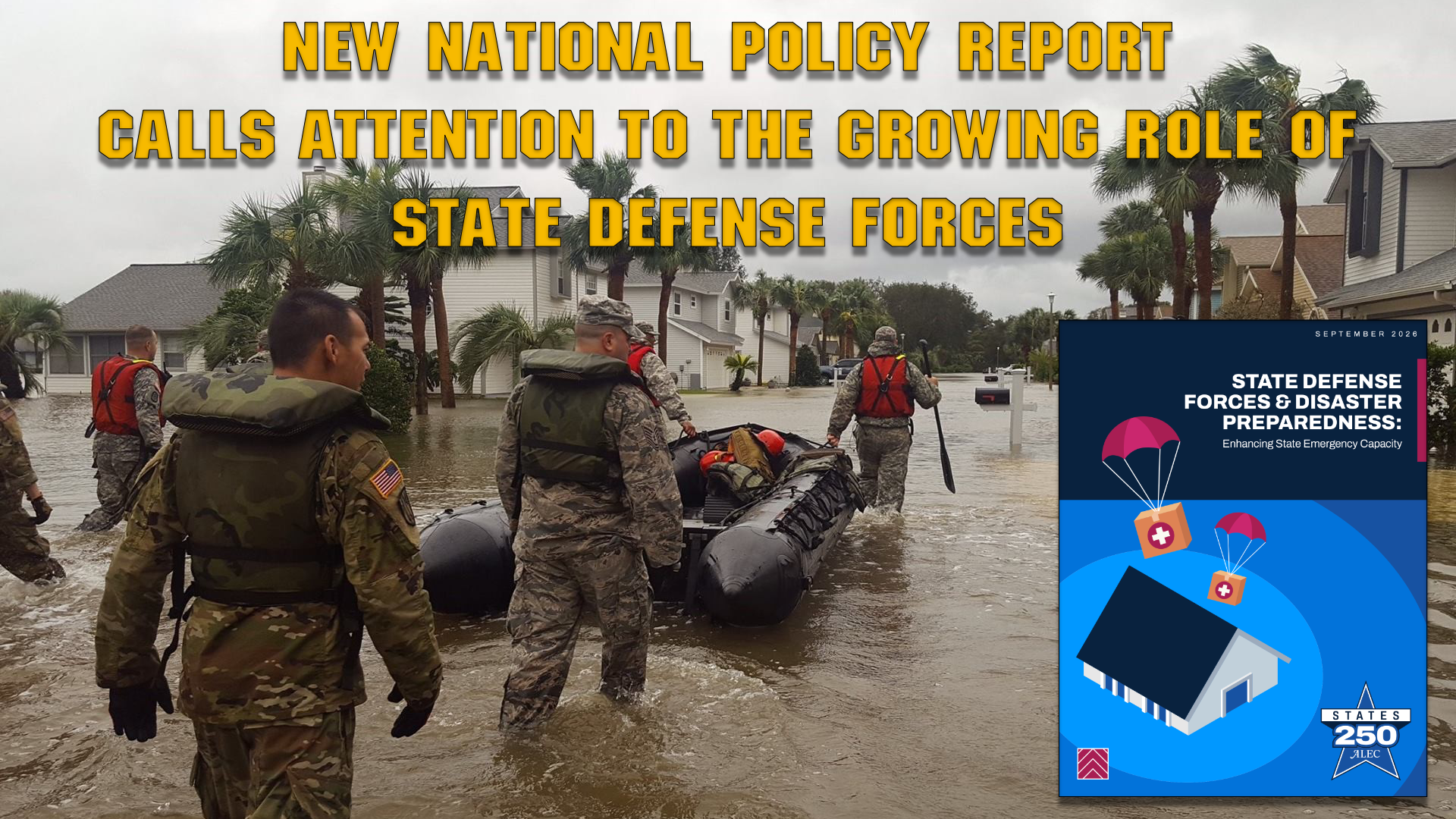
The American Legislative Exchange Council (ALEC) has released a new policy paper examining the role State Defense Forces can play in strengthening state disaster preparedness and emergency response capabilities. ALEC describes itself as the nation’s largest nonpartisan, voluntary membership organization of state legislators and says its work is centered on the principles of limited government, free markets and federalism. The organization brings together state lawmakers, policy experts, business leaders and other stakeholders to exchange policy ideas, conduct research and develop state-level policy proposals. ALEC reports having more than 2,000 legislative members nationwide and operates several policy task forces, including its Veterans and Military Affairs Task Force, which was established in 2025.
Their report published in September 2026, “State Defense Forces & Disaster Preparedness: Enhancing State Emergency Capacity” examines the history, modern missions and potential future role of State Defense Forces. The paper argues that State Defense Forces represent a reliable and comparatively low-cost source of military manpower that remains permanently under state control. Unlike the National Guard, State Defense Forces cannot be federalized and deployed outside their states by the federal government, allowing governors to retain a military force for disaster response, homeland security and other state missions when National Guard forces are deployed elsewhere. ALEC notes that 20 states and Puerto Rico currently maintain State Defense Forces, while 30 states do not.
The report traces State Defense Forces from America’s early militia system through World War I, World War II, the Korean War and the Cold War, illustrating how states repeatedly expanded or reestablished their own military forces when the National Guard was mobilized for federal service. ALEC argues that the issue has become increasingly relevant as the National Guard has become more deeply integrated into the federal military’s operational structure. The paper also emphasizes the comparatively small financial investment required to maintain many State Defense Forces, noting that the forces in Virginia, Texas and California receive less than one percent of their respective states’ defense preparedness budgets while providing trained personnel for emergency management, communications, medical support, search and rescue, cybersecurity and numerous other missions.
To demonstrate how these forces operate today, ALEC highlights three State Defense Forces of very different sizes: the Florida State Guard, Virginia Defense Force and Indiana Guard Reserve. The report details the Florida State Guard’s rapid expansion and deployment during Hurricanes Debby, Helene and Milton; the Virginia Defense Force’s emergency-management, communications and cyber capabilities, including its Cyber Battalion; and the Indiana Guard Reserve’s support of National Guard training and emergency preparedness despite having a force of roughly 70 members. ALEC concludes that State Defense Forces can provide states with specialized, cost-effective capabilities while ensuring governors retain additional trained military manpower during disasters, National Guard deployments and other emergencies. The complete ALEC report is available below.
Read the PDF Here:
Sources: American Legislative Exchange Council (ALEC) – About ALEC – State Defense Forces & Disaster Preparedness: Enhancing State Emergency Capacity – Special Thank you to Hope T. For Alerting Us To This News.