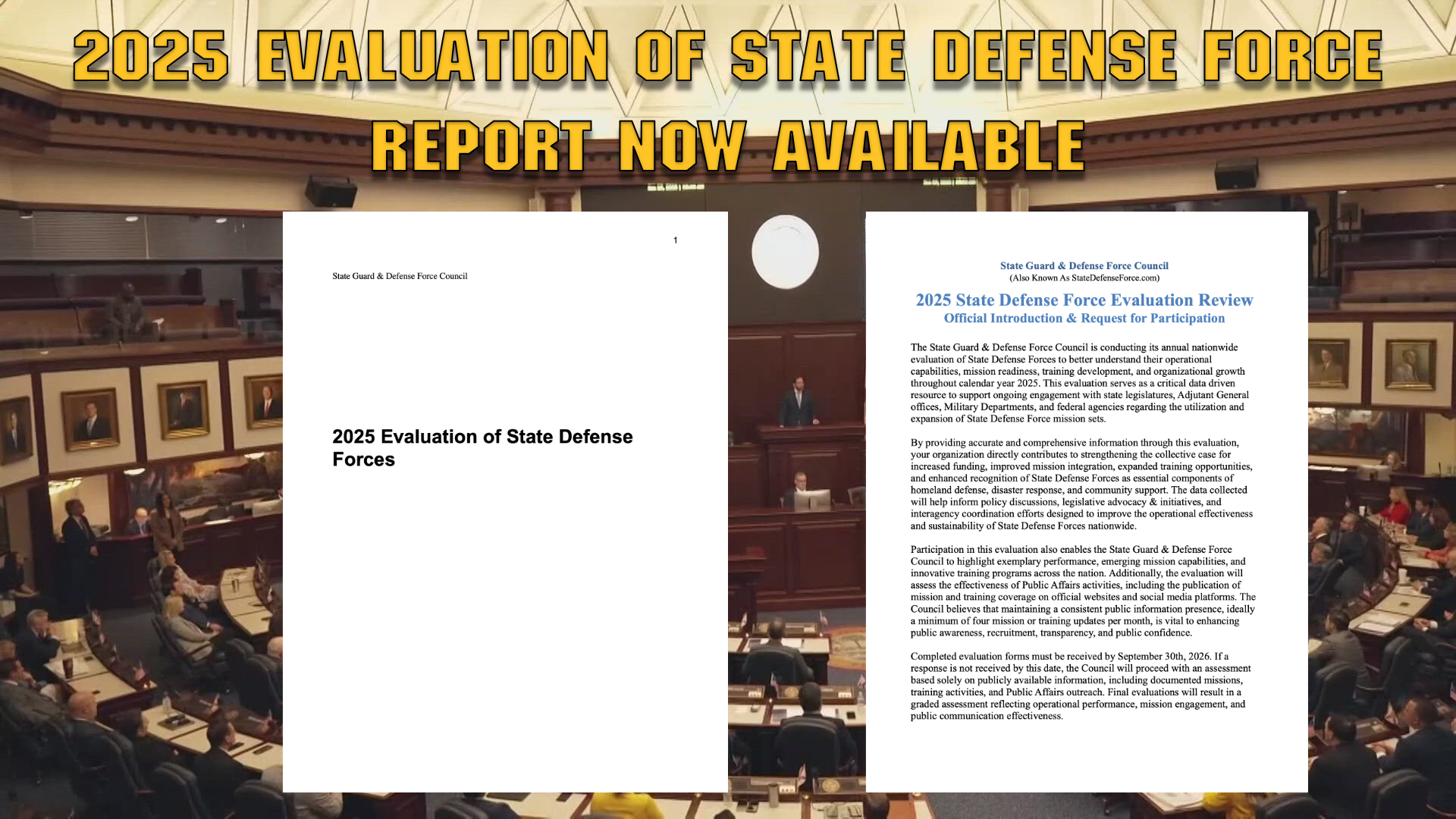
The State Guard & Defense Force Council, also known as StateDefenseForce.com, has officially launched the 2025 State Defense Force Evaluation Review, a nationwide assessment designed to document the readiness, operational capabilities, missions, resources, and organizational development of State Defense Forces, State Guards, and Naval Militias throughout the United States and its territories.
The evaluation will examine the work performed by these organizations during calendar year 2025 and will help determine the recipients of the 2025 Best State Defense Force Award, 2025 Runner-Up State Defense Force Award, and 2025 Most Improved State Defense Force Award.
This year’s review represents one of the Council’s most comprehensive State Defense Force evaluations to date. It expands upon previous SGDFC research projects and recent discussions with members of our Patreon community concerning the development of naval, maritime, aviation, aerial, and unmanned aircraft components within America’s State Defense Forces.
Creating a National Picture of State Defense Force Readiness
State Defense Forces have increasingly become important components of state emergency-response and homeland-defense systems. Their personnel support National Guard units, emergency-management agencies, law-enforcement organizations, public-health authorities, and local communities during natural disasters, major emergencies, public events, and other state missions.
Despite their growing importance, there remains no single nationwide governmental report that fully documents the personnel, missions, budgets, training programs, equipment, benefits, and operational capabilities of every State Defense Force.
The 2025 evaluation is intended to help address that information gap.
The review will document the current condition, readiness, resources, organizational development, and operational effectiveness of participating organizations. The information collected will also help identify strengths, capability gaps, personnel challenges, funding needs, emerging mission areas, effective programs, and opportunities for future force development.
The resulting data may be used to support research, policy recommendations to State & Federal Lawmakers, The Department of War, The National Guard Bureau, Stat legislative proposals, appropriations requests, emergency-capability planning, and efforts to improve the recognition, training, benefits, legal protections, funding, and operational integration of State Defense Forces.
Missions, Training and Personnel Strength
Participating organizations are being asked to document the missions they performed during 2025, including emergency activations, community-support operations, joint missions with the National Guard, and major interagency training exercises.
The evaluation also requests information concerning:
- New mission sets and training programs established during 2025
- The number of personnel trained or certified for individual missions
- The frequency with which those capabilities are exercised
- Fiscal-year budgets and funding sources
- Enlisted, officer, warrant officer, civilian, and auxiliary personnel strength
- Recruitment and retention
- Public-affairs and recruiting activities
- Equipment, facilities, certifications, and professional development
- Changes in state law, military regulations, command policies, or operational authority
The Council will evaluate not only what missions a force is officially authorized to perform, but also whether the organization possesses sufficient trained personnel, equipment, funding, and opportunities to maintain those capabilities.
Expanded Review of Naval and Maritime Components
The questionnaire asks whether each state maintains a maritime or naval component, how those components are organized, its relationship to the State Defense Force chain of command, and the number of personnel assigned.
Organizations may report patrol vessels, search-and-rescue boats, utility and transportation craft, rigid-hull inflatable boats, inflatable rescue boats, personal watercraft, training vessels, and other waterborne equipment available for official missions.
The maritime section also examines capabilities such as:
- Maritime search and rescue
- Flood rescue
- Waterborne transportation
- Port and harbor security support
- Emergency supply delivery
- Evacuation operations
- Dive operations
- Waterway patrols
- Maritime communications
- Environmental and damage assessment
- Support to the National Guard
- Support to law enforcement and emergency-management agencies
The evaluation requests the number of maritime missions, activations, and major training exercises completed during 2025, as well as information concerning recognized maritime certifications held by participating personnel.
Aviation, Aerial and Unmanned Aircraft Capabilities
The evaluation also contains an expanded review of aviation, aerial, and unmanned aircraft systems.
State Defense Forces are being asked whether they operate or are developing fixed-wing aircraft, rotary-wing aircraft, small unmanned aircraft systems, larger unmanned platforms, tethered observation systems, or other aerial capabilities.
The review examines the number of pilots, FAA-certified remote pilots, aircrew members, maintenance personnel, observers, and mission specialists assigned to those programs. It also requests information concerning the number of available and mission-ready aircraft or systems and whether they are state-owned, assigned, leased, loaned, donated, or otherwise authorized for official operations.
Potential aerial missions documented in the evaluation include:
- Aerial search and rescue
- Missing-person searches
- Disaster and infrastructure assessment
- Aerial photography and mapping
- Flood, fire, and storm-damage assessment
- Communications relay
- Transportation of personnel or supplies
- Medical transportation support
- Security and situational awareness
- Support to emergency-management agencies
- Support to the National Guard
- Support to law-enforcement, fire, and other government agencies
The Council hopes that this information will establish a clearer nationwide understanding of how State Defense Forces are using aviation and unmanned systems and where additional funding, equipment, training, or statutory authority may be needed.
Reviewing Outside Organizational Support
The evaluation contains a detailed section examining the relationship between State Defense Forces and the State Guard Association of the United States, commonly known as SGAUS.
Organizations may report whether they received direct financial assistance, equipment, no-cost training, professional-development programs, recruiting support, public-affairs assistance, legislative advocacy, or assistance communicating with lawmakers and State Military Departments.
The review also asks whether SGAUS courses are officially recognized, entered into personnel records, required for certain positions, or authorized for the wear of related awards and insignia.
Courses covered by the evaluation include the Military Emergency Management Specialist program, professional military education, cyber, behavioral-health and chaplaincy training, search and rescue, medical, engineering, hazardous-materials, emergency communications, unmanned-aircraft operations, legal, public-information, and recruiting programs.
Uniform Policy, Recruitment and Organizational Identity
Another major portion of the evaluation examines uniform policies and their possible effect on recruitment, retention, morale, participation, and organizational identity.
State Defense Forces are being asked to document their currently authorized utility, duty, service, ceremonial, physical-fitness, and administrative uniforms. The questionnaire also examines uniform changes made since March 7, 2024 (Introduction of The Updated National Guard Bureau Instruction CNGBI 5500.01A), including changes to name tapes, rank insignia, patrol caps, identification patches, state flags, organizational insignia, skill badges, and federal awards or qualification badges.
The evaluation asks which governmental or military authority proposed and approved each change and whether the State Defense Force commander or uniform committee were consulted.
Organizations that have adopted polo shirts, khaki trousers, or other civilian-style uniforms are also being asked to explain why those uniforms were introduced, which missions they may be worn during, and whether their adoption affected military identity, recruiting, retention, discipline, morale, or public recognition.
Legislative and Policy Research
The evaluation will serve as more than an award questionnaire. It will also operate as a nationwide legislative and policy research instrument.
State Defense Forces are being asked to identify laws, executive orders, regulations, budget decisions, command policies, and military directives that have affected their organization since January 1, 2024.
Areas covered include:
- State Active Duty compensation
- Workers’ compensation and injury coverage
- Employment protections
- Educational benefits
- Missions and legal authority
- Funding and equipment
- Training access
- Recruiting and retention
- Promotions and awards
- Uniform policy
- Relations with the National Guard
- Public affairs
- Personnel strength and organizational structure
The questionnaire also asks whether any previously authorized mission has been expanded, restricted, suspended, transferred to another agency, or eliminated.
This information may assist the Council in developing future legislative proposals, policy recommendations, appropriations requests, and advocacy initiatives intended to strengthen existing State Defense Forces and support states considering the establishment or reactivation of their own force.
Public Affairs and GoStateGuard.com
The evaluation places particular emphasis on public communication.
Participating organizations are being asked to provide information concerning their official Public Affairs Officer, recruiting website, public-information activities, and the frequency with which missions and training events are shared with the public.
The Council believes State Defense Forces should strive to publish at least four mission or training updates each month. A consistent public-information presence can improve public awareness, recruiting, transparency, public confidence, and recognition of the service performed by State Defense Force personnel.
Commands may also authorize the Council to publish their official recruiting website on the upcoming GoStateGuard.com platform. The website is being developed to help prospective volunteers learn what State Defense Forces are, locate official recruiting resources, and obtain basic information concerning eligibility, missions, State Active Duty compensation, workers’ compensation, injury coverage, training requirements, and available benefits.
Participation and Submission Deadline
Participation in the evaluation is voluntary. Organizations may authorize direct attribution of their responses, permit aggregated use only, require prior review before publication, or restrict individual responses.
The Council specifically instructs participating organizations not to submit classified information, controlled unclassified information, law-enforcement-sensitive material, personally identifiable information, security vulnerabilities, communications frequencies, access-control procedures, detailed deployment plans, or other information restricted from public release.
General personnel totals, equipment categories, training statistics, mission capabilities, and publicly releasable policy information are sufficient.
Completed evaluations must be received by September 30, 2026. Organizations requiring additional time because of command review, legal review, records collection, operational activation, or other official circumstances may request a limited extension before the deadline.
When an official response is not received, the Council may proceed with an assessment based solely upon publicly available information, including documented missions, training activities, official reports, websites, and Public Affairs outreach.
Completed evaluations and questions may be submitted to:
Download the Evaluation Documents
Commands, Public Affairs Officers, staff officers, and authorized representatives may download both documents below:
Click Here To Download The Introductory Letter
Click Here to Download The 2025 State Defense Force Evaluation Report
You can also obtain the documents on our sister site – The State Guard Administration